Pikettys Bestseller über den Kapitalismus und seine fatalen Mängel habe ich nicht gelesen und über seine Schlussfolgerungen – massive steuerliche Mehrbelastung der Superreichen – bin ich nur oberflächlich orientiert. Hege aber eine instinktive Skepsis. Gelesen habe ich dafür seinen Blogbeitrag bei LeMonde mit einer Analyse der Produktivität und ihrer Entwicklung in einer Reihe von Ländern und insbesondere einem Vergleich von Deutschland und Frankreich, der überaus interessant ist und jede Menge an Fragen aufwirft. Piketty definiert Produktivität schlicht aus der Division von Sozialprodukt und Anzahl geleisteter Arbeitsstunden. Über die Mängel der Definition ist er sich im klaren, hat aber Einwände gegen die näherliegende Definition als Quotienten aus Volkseinkommen und Arbeitsstunden.
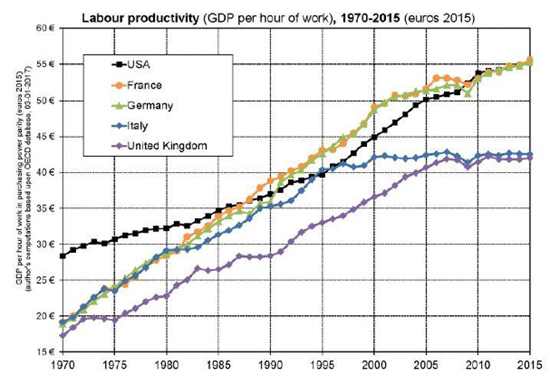
Was auffällt, ist ab 2000 das Wegbrechen von Italien und Grossbritannien und der anhaltende Gleichschritt von USA, Deutschland und Frankreich. Was ist da passiert? Was ist in Italien geschehen? Ich vermute, hier machen sich erstmals und dramatisch die Konsequenzen des Euros bemerkbar, was P. als Anhänger der Einheitswährung wohl nicht sehen will. GB fällt ab ca. 2008 zurück, auch ohne Euro, während Frankreich im Gleichschritt mit den USA und D vorwärts marschiert. Wie ist das zu interpretieren?
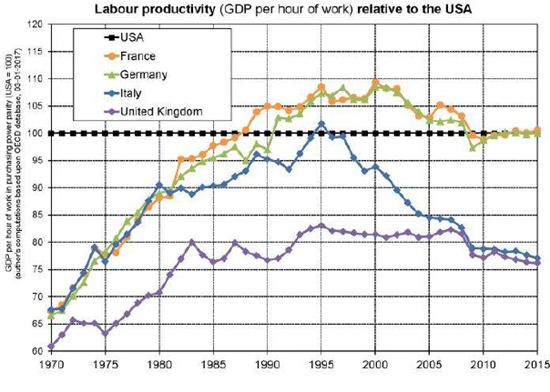
Noch auffallender, wenn man die Zahlen akzeptiert, ist die Tatsache, dass USA, D und F gleichauf liegen, I und GB hingegen weit hinter den USA als Massstab zurückfallen. Das ist der selbe Tatbestand wie in der ersten Grafik, mit anderer Optik und den USA als Massstab.
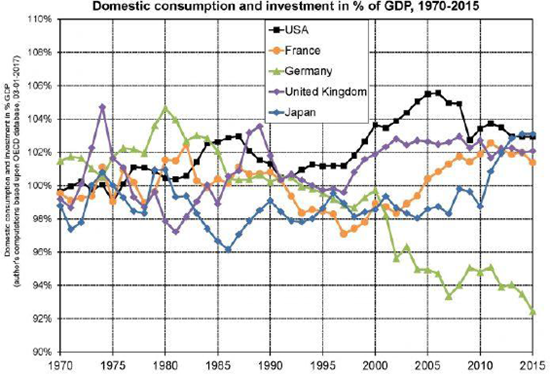
Was Piketty besonders stört, ist das tiefe Konsum und Investitionsniveau in Deutschland, das deutlich von allen Vergleichsländern abweicht. Wo gehen dann aber die Ueberschüsse hin? Der deutsche Staat hat sich bis ca. 2015 stets weiter verschulden müssen, die Realeinkommen in Deutschland haben nicht wesentlich zugenommen. Sind sie bei den Unternehmen gelandet?
Und das geht einher mit enormen Exportüberschüssen in Deutschland. Piketty kommentiert:
After unification, the German governments were very afraid of a drop-off in the competitiveness of the German production site‘. They adopted wage-freeze policies to increase productivity and they probably went too far in this direction. At the same time, the entry of Central and Eastern European countries into the European Union enabled German firms to achieve an increased and highly advantageous integration with these new countries. This can be seen in particular with the explosion of the general level of imports and exports, which were very similar to the level in France in 2000 (close to 25%-30% of GDP) and which in 2015 rose to 40%-45% of GDP in Germany (as compared with 30% in France; see the graph above).
This all led to a trade surplus which was doubtless not entirely foreseeable and is in large part due to contingent factors. In its own way, it is an illustration of the strength of the economic forces at play in globalisation which public authorities have not yet learnt to regulate correctly.
We must also stress the fact that there is quite simply no example in economic history (at least not since the beginning of trade statistics, that is, since the beginning of the 191h century) of a country of this size which has experienced a comparable level of trade surplus on a long-term basis (not even China or Japan which in most instances have not risen above 2%-3% in trade surplus). The only examples of countries experiencing trade surpluses in the region of 10% of GDP are oil-producing countries with a relatively small population and with a GDP much lower than that of Germany. Another indication of the fact that the German surpluses are objectively excessive is due to the poor foreign investments made by firms and the financial system; in contrast to the United States the financial assets accumulated by Germany in the rest of the world are much lower than the amount which the addition of the trade surpluses should have produced.
The solution today would of course be to boost wages, consumption and investment in Germany, both in the educational system as well as the infrastructures. Unfortunately this is being implemented too slowly. The German leaders have an enormous responsibility here; they have other qualities (in particular in their reception policies for migrants) but on this basic point, they have not explained the issues to their public opinion and have even tended to present the trade surplus as a subject for national pride, even a proof of German virtue, which is quite simply beside the point. The German tendency to lecture the rest of Europe and to explain that everything would be fine if everyone copied Germany is logically absurd. If every country in the Euro zone had a trade surplus of 8% GDP, there would be nobody in the world to absorb a surplus of this type (simply because there is on the planet no country of the size of the euro zone that is ready to have a trade deficit of 8%). This irrational tendency is unfortunately one of the risks of globalisation and the heightened competition between countries: we all try first to find a refuge and then to survive.
Fortunately, there are other forces in play, in particular the attachment to the European idea. If the other countries, beginning with France, Italy and Spain (or a total of 50% of the population and the GDP of the Euro zone, as compared with 27% for Germany) were to decide democratically in a joint parliamentary chamber on the formulation of a detailed proposal for a democratic re-foundation of the Euro Zone, including a spur to economic growth and a moratorium on public debts, I am convinced that a compromise can still be found. But it is unlikely that any solution will come from Germany and the transition may be far from smooth. Considerable wrangling will doubtless be required. All that we can hope for is that the clashes will not be too violent; after Brexit, nobody can claim to be unaware of how far this might go.
I would like to end on a positive note. If we compare France and Germany with the United States, the United Kingdom and other, still further, parts of the globe, then they have much in common. In the decades following the self-destructive behaviour of the years 1914-1945, these two countries have succeeded in constructing institutions and policies which have enabled the development of the most social and the most productive economies in the world. France and Germany still have major tasks to accomplish together to promote a model of fair and sustainable development. But they must not get lost in mistaken comparisons which prevent them from advancing towards the future and accepting the idea that they each have a lot to learn from the other and from history.
(noch zu bearbeiten)
 wirth.blog
Du muss angemeldet sein, um einen Kommentar zu veröffentlichen.