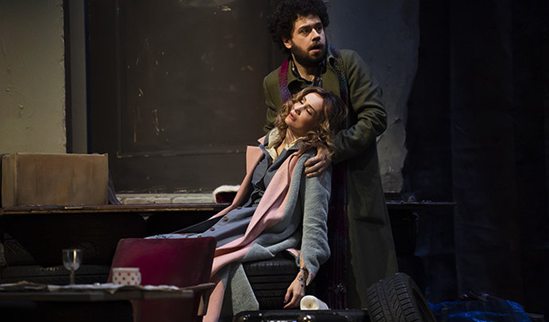
Zum Jahresausklang in der Sylvester-Aufführung von La Bohème im Theater. Wunderbare, magische Musik, grossartige Sänger.
Die Inszenierung: wieder eine erzwungene Aktualisierung, die der Musik und der Geschichte nichts Sinnvolles hinzufügt, sie bloss belastet wenn nicht missbraucht. Aber die Musik stammt aus dem 19. Jht., die Geschichte ist in Paris 1830 angesiedelt und der Text ist davon geprägt. Das wird nie 21. Jht., es ist bloss forciert und peinlich.
Das Leid der armen Künstler berührt nicht, auch wenn sie zu schwulen Hip Hoppern und Graffity Artists umfunktioniert werden. Die Sozialkritik kann hier nicht ansetzen. Die Künstler sind lieb und arm und die Reichen bös. Wer sollte davon betroffen sein?Wenn Mimi von ihrem argen Husten singt und dann offensichtlich (Haarausfall) an Krebs stirbt, dann kann das nicht funktionieren, weil es eine Chemo 1830 nicht gab. Etc. etc.
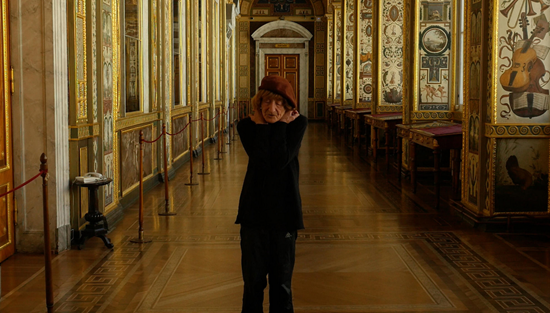
Oleg Karavaichuk (1927-2016), Russischer Pianist und Komponist. Ich bin durch einen Film auf Arte auf ihn gestossen. Der spanische Film wurde ein Jahr vor seinem Tod gedreht.
Ein merkwürdiger Mensch. Man weiss nicht ob Mann oder Frau, je älter je fraulicher, vielleicht. Mit einer Musik zwischen allen Stühlen. Walzer und Minimal mit “emanzipierter Dissonanz” gemäss Schönberg. Grossartige Musik. Sehr stark.
Beeindruckend, berührend in seiner absoluten Hingabe an die Musik.
Mit russischer Schreibweise auch auf Spotify mit einigen Aufnahmen aufzufinden.
Just like his compositions that mix consonance and dissonance, Oleg Nikolaevich Karavaichuk is an ever-changing character in this affectionate portrait, which retains a certain mystery. When the androgynous octogenarian passes through the corridors of the Hermitage Palace to sit at Tsar Nicholas’s magnificent piano, his remarks on the contrast between the snow-covered streets of Saint Petersburg and the architectural and historical force of the place set the tone of the film: each digression in his conversation and music is anchored in the intensity of his feeling for textures and matter. So Oleg concludes a political anti-Putin lament with a note of olfactory melancholy: “Why does the fruit at the market no longer have a smell?” What indeed, in today’s Russia, no longer touches the senses, or even the sentiments?
The pianist, who wrote scores for Sergei Parajanov and Kira Muratova, sometimes seems almost delirious, but above all he incarnates in a single body his country’s recent upheavals. The disaffection he mentions is echoed by the splendid shots of his deserted dacha, where the library is intact but for a Lenin lying forgotten on the floor. With his high-pitched voice and often tactile metaphors, this artist – who seems to have traversed the centuries – is in himself a Russian ark. (Charlotte Garson)
Nach der verklärten Nacht ein weiteres Vordringen zu Schönberg: Das Streichquartett Nr. 1 und die sechs kleinen Klavierstücke. Zum Streichquartett schreibt Greenberg:
An important work is Schoenbergfs String Quartet No. 1 in D minor of 1905. It is a long piece cast in four continuous movements. Three aspects of the quartet emphasize its modernity. First is its incredible polyphonic intensity: Each of the four instruments of the quartet is a soloist much of time. Second, Schoenbergfs phrases are not balanced, poetic phrases with antecedent and consequent structures. Rather, they are prose.like, open ended, and rhapsodic. Third, the variety of string quartet textures Schoenberg employs is mind.boggling.
Zum frühen Werk schreibt er:
Schoenberg believed in melody more than anything else. As the first years of the 20th century progressed, he ceased to believe in the tonal harmonic system. By 1908, Schoenberg had come to the conclusion that functional harmony stifled and constrained melody by forcing it to adhere to what he believed were “artificial” constructs: chords built by stacking thirds and chord progressions based on harmonic motion by perfect fifths.
Schoenberg began to perceive his artistic mission as that of a simplifier, no small irony given how difficult his music can be for the uninitiated listener. Between 1908 and 1913, Schoenberg composed a series of experimental works that remain among the great masterworks of the 20th century, including the Five Pieces for Orchestra, Op. 16 (1909), Erwartung, Op. 17 (1909); Pierrot Lunaire, Op. 21 (1912), and Die glückliche Hand (1913).
To describe his work, Schoenberg preferred the word pantonal, implying that his music embraced a sort of all‑encompassing ur‑tonality. This course will simply call it nontonal.
Greenberg ist in seiner Serie zur Great Music of the 20th century über alle Massen begeistert über den Sacre du Printemps von Stravinsky. Und zu recht.
Stravinsky gehört auch auf meiner Liste zu den vier massgeblichen oder am meisten herausragenden Musikern / Orchestern … des 20. Jhts. (Zusammen mit Miles Davis, den Beatles und Debussy (?).
Und der Sacre ist und bleibt überwältigende Musik. Das YouTube-Video obgleich in sehr bescheidener Qualität vermittelt die ungeheure Kraft und Energie und Vitalität.
Greenberg schreibt: The Rite appeared to be devoid of any reference to the long and glorious Western musical tradition as it existed at the time. Rather, it created what appeared to be an entirely new musical language and expressive world.a primal, sexual, violent, thrumming, premoral musical world in which pure rhythmic energy for its own sake became the principal musical element. In terms of its expressive content, The Rite has been described as a metaphor for the breakdown of 19th.century values, as a symbol of the post.Victorian sexual awakening of the early 20th century, and even as an analog for the modern technology that led to the butchery of the First World War.
 wirth.blog
Du muss angemeldet sein, um einen Kommentar zu veröffentlichen.