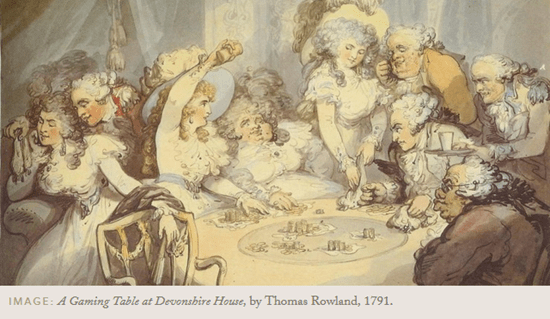
aleatory: Dependent on uncertain events or occurrences; haphazard, random. From Latin aleatorius, belonging to or connected with gamblers or games of chance; aleator, gambler, dice player; alea, die, dice (of unknown origin).
apophenia: The tendency to perceive connections or meaningful patterns in random data; often used in ref. to divination, as in reading of tea leaves, or Roman practice of finding meaning in entrails. (See also gambler’s fallacy.)
auspicious: Of good omen; betokening success. From Latin auspicium, divination by observing flights of birds.
Bayern luck: The belief that the football club Bayern Munich frequently wins in the last minute of a match.
chance: Something unpredictable that happens without any discernible human cause. From Old French cheance, Provençal cazensa, Italian cadenza, via late Latin cadentia, falling.
depressive realism: A psychological hypothesis that claims depressed people judge their control of events more accurately than do nondepressed people.
doom: A law or ordinance, esp. in Anglo-Saxon England; unhappy destiny. “All unavoided is the doom of destiny.”—William Shakespeare, Richard III
fate: Inevitable necessity; destiny depending on a superior and uncontrollable cause. From Latin fatum, that which has been spoken.
fluke: Lucky stroke, chance hit (1857). Also flook, said to be originally a lucky shot at billiards (of uncertain origin); may be connected with fluke in ref. to whale’s use of flukes to swim rapidly. OED allows only that fluke is “possibly of Eng. dialectal origin.”
Fortuna: Goddess of luck in Roman and Greek (as Tyche) culture. Not always benevolent: she could be fickle (Fortuna Brevis), doubtful (Fortuna Dubia), or evil (Fortuna Mala). From Latin vortumna, she who turns the year about.
fortune-teller: “One who cheats common people by pretending to the knowledge of futurity.”—Samuel Johnson, Dictionary of the English Language
gambler’s fallacy: The expectation of a reversal following a run of one particular outcome (e.g., expecting a coin flip to come up heads after a run of tails). (See also apophenia.)
gris-gris: An African amulet; a small cloth bag inscribed with words from the Qur’an. Also, Louisiana voodoo term for bewitch.
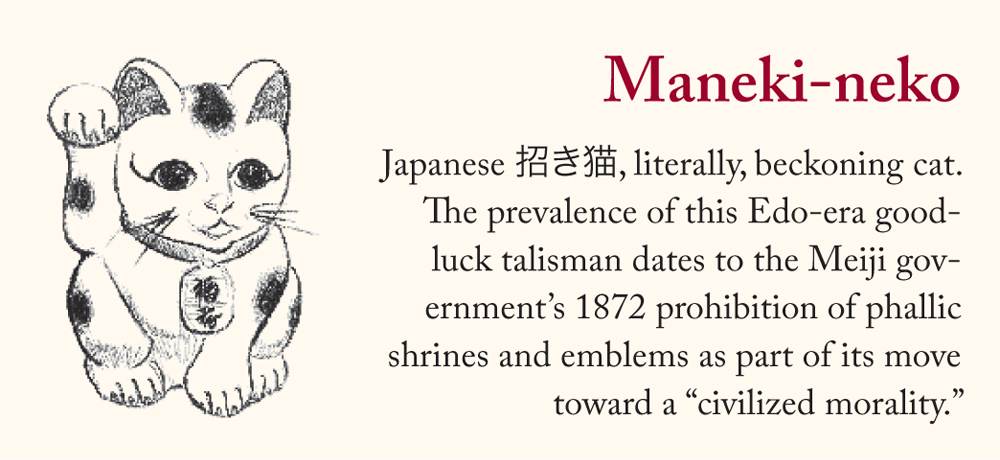
Japanese beckoning cat, a lucky talisman.
happiness: From 13th cent. English substantive hap, deriving from Old Norse happ, chance or good luck. Verb happen and adverb haply (by chance) emerged from this root in 14th cent., as did happy, originally meaning prosperous. By 16th cent. the word had acquired its connotation of contentment and pleasure.
hazard: A dice game similar to craps in which chances are complicated by arbitrary rules. From Old French hasard, -art (12th cent.); compare Spanish azar, Italian la zara, azzardo, medieval Latin azardum, azarum. From Arabic al-zahr, die. William of Tyre said the name derives from Palestinian castle Hasart (or Asart), during the siege of which the game was invented. The actual name of the castle appears to have been Ain Zarba.
hex: Pennsylvania Dutch for a magic spell or curse; a witch. Corrupt German for witch.
Irish lottery: To have sex without a condom or other form of birth control.
jackal’s horn: A bony excrescence on skull of golden jackal, used as talisman; in Nepal, according to shamans, it is good for gambling.
jinx: A charm, a spell. From Latin jynx, iynx, Greek ἴυγξ, wryneck (Jynx torquilla), a bird used in witchcraft.
kismet: Turkish for destiny or fate. From Persian qismat, Arabic qisma(t), portion, lot, fate, qasama, to divide.
lucktard: One whose dumb luck bails him out of any difficulties.
lucky: (Hist. and rare) A woman who brews or sells beer; a landlady of a public house or tavern (“Lady Onlie, honest lucky, brews gude ale at shore o’ Bucky.”—Robert Burns); a witch.
lucky water: Vodka in a water bottle.
mascot: A person, animal, or object adopted as symbolic figure, esp. to bring good luck. From French mascotte, sorcerer’s charm, medieval Latin masca, mask, specter, witch.
mazel: Yiddish for luck, fortune; spec. good luck. From modern Hebrew mazzal, luck. Compare Hebrew mazzalot, planets. (See also schlimazel.)
mojo: In recent use, power, force, or influence of any kind. Origin uncertain. Perhaps of African origin; compare Gullah moco, witchcraft, magic.
nelson: In cricket, individual or team scores of 111 or multiples thereof (e.g., double nelson, triple nelson). Thought to ref. Lord Nelson’s lost eye, arm, and leg. (Nelson never lost a leg.) According to superstition, bad things occur on these scores.
on the pig’s back: Irish phrase for being in luck’s way. From Rome; during reign of Twelve Caesars, a golden amulet in the shape of a pig was supposed to bring good luck.
pari-mutuel: French for a form of betting in which those backing the first three horses divide the losers’ stakes; pari, wager, and mutuel, mutual. First known use, 1872.
pothariko: Greek for good or bad luck associated with the first person to step over a threshold on New Year’s Day; the first foot.
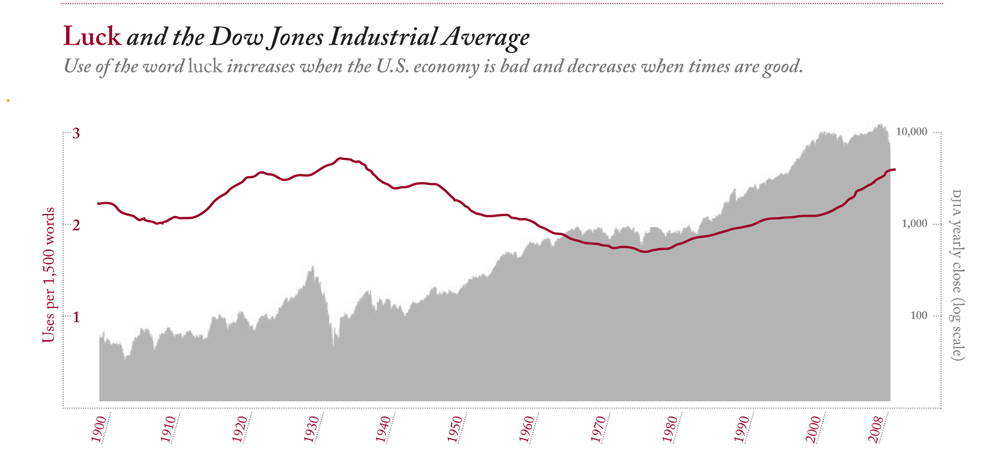
Based on Google Ngram Viewer, the frequency of the word “luck” between 1896 and 2008, from a database of over 5 million books. Historical logarithmic graph of the Dow Jones Industrial Average from 1896 to 2008.
potluck: To take one’s chances, to take whatever is available, to be willing to take whatever one is given (1592). N. Amer.: A communal meal to which those invited bring a dish to share, sometimes without arranging beforehand which dish to bring (1867).
probability: (Obs.) Worthy of approval. “Such a fact is probable but undoubtedly false.”—Edward Gibbon (1788). “This was the first view I had of living comfortably indeed, and it was a very probable way.”—Daniel Defoe (1724). First used in print in ref. to numerical ideas of randomness, 1662.
risk: A combination of an event’s probability and its negative consequences. French risque, danger or inconvenience. Postclassical Latin resicum, risicum, hazard or danger in commercial contexts. Compare 16th cent. Spanish riesgo, conflict, disagreement, possibility of unpleasant consequences.
serendipity: The faculty of making providential discoveries by accident. Coined by Horace Walpole in 1754. From fairy tale (orig. Persian) “Three Princes of Serendip,” first published in Venice in 1557.
schlimazel: Yiddish for consistently unlucky, accident-prone person; born loser. From Middle High German slim, crooked, and Hebrew mazzal, luck. (See also mazel.)
snakebit: To have or experience failure or bad luck. First use, 1957.
S.O.L.: Acronym of “shit out of luck”; state of having run out of all other options. OED also offers soldier, strictly, surely out of luck. Slang used by American Expeditionary Force in World War I (1917).
swastika: A symbol originally representing happiness, pleasure, good fortune. From Sanskrit svastika, svastí, well-being, luck; from sú, good, and astí, being. Adopted as symbol (Hakenkreuz) of Nazi Party, 1920.
talisman: An object held to act as charm to avert evil and bring good fortune. From Arabic tilsam, Middle Greek telesma, Greek, telein, to initiate into mysteries.
Tycho Brahe days: Days that are judged to be especially unlucky. From Swedish Tycho Brahe-dagar. After the Danish astronomer, who believed these dates were not conducive to success.
laphamsquarterly.org
 Unterbewusste hat offenbar stark an Faszination eingebüsst. Man fragt sich, ob es dereinst bewusste Maschinen geben wird. Ob diese auch ein Un- oder Unterbewusstes haben werden, auf die Frage scheint noch niemand gekommen zu sein. Cormag McCarthy ist auf Nautilus dem Unterbewussten nachgegangen, und welche Rolle die Sprache spielt.
  wirth.blog
Du muss angemeldet sein, um einen Kommentar zu veröffentlichen.