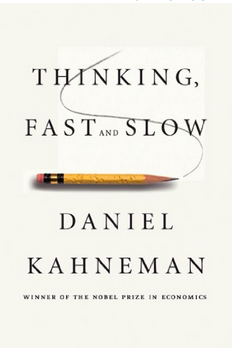
Daniel Kahnemann entwickelt in seinem Buch einen Strauss bemerkenswerter Ideen. Hier habe ich seine Ueberlegungen zum Thema “Remembering Self” und “Experiencing Self” in Zitaten zusammengefasst. Dahinter steht die Rolle der Narration, der Erzählung, die wir zu jeder Erfahrung abgeben. Sie wird ausgelöst durch die Erfahrung und färbt sie gleichzeitig ein. Sie ist Teil des kognitiven Prozesses, unverzichtbar und unvermeidlich, und sie ist gefährlich. Wenigstens solange sie nicht bewusst wahrgenommen wird, scheint mir. Und sie wird wohl nur selten falls überhaupt wahrgenommen und dann als zwingend und nicht als beliebig und manipuliert resp. manipulierbar erfahren. Was Kahnemann nicht sieht oder nicht ausspricht: hier könnte ein entscheidender Schritt zur Freiheit des Seins vorliegen.
Immerhin klingt bei ihm Kritik an der gängigen Einstellung an, dass der Erinnerung weit grösseren Wert beigemessen wird als der unmittelbaren Erfahrung.
Ein anderes Thema, das Kahnemann in diesem Kapitel anschneidet ist die Art und Weise, wie das Remembering Self in der Narration vorgeht. Entscheidend sind die Peak-Erfahrung und das Ende. Keine Rolle spielt die Dauer.
Harari nimmt viele dieser Ideen in seinem “Homo Deus” auf, um die Vorstellungen des rationalen, humanistischen Liberalismus zu zerlegen.
The Statistical analysis revealed two findings, which illustrate a pattern we have observed in other experiments:
· Peak-end rule: The global retrospective rating was well predicted by the average of the level of pain reported at the worst moment of the experience and at its end.
· Duration neglect: The duration of the procedure had no effect whatsoever on the ratings of total pain.
The remembering self is sometimes wrong, but it is the one that keeps score and governs what we learn from living, and it is the one that makes decisions. What we learn from the past is to maximize the qualities of our future memories, not necessarily of our future experience. This is the tyranny of the remembering self.
For an objective observer evaluating the episode from the reports of the experiencing self, what counts is the „area under the curve“ that integrates pain over time; it has the nature of a sum. The memory that the remembering self keeps, in contrast, is a representative moment, strongly influenced by the peak and the end. Of course, evolution could have designed animals‘ memory to store integrals, as it surely does in some cases. It is important for a squirrel to „know“ the total amount of food it has stored, and a representation of the average size of the nuts would not be a good substitute. However, the integral of pain or pleasure over time may be less biologically significant.
Of course, evolution could have designed animals‘ memory to store integrals, as it surely does in some cases. It is important for a squirrel to „know“ the total amount of food it has stored, and a representation of the average size of the nuts would not be a good substitute. However, the integral of pain or pleasure over time may be less biologically significant.
Decisions that do not produce the best possible experience and erroneous forecasts of future feelings-both are bad news for believers in the rationality of choice.
Tastes and decisions are shaped by memories, and the memories can be wrong. The evidence presents a profound challenge to the idea that humans have consistent preferences and know how to maximize them, a cornerstone of the rational-agent model.
An inconsistency is built into the design of our minds. We have strong preferences about the duration of our experiences of pain and pleasure. We want pain to be brief and pleasure to last. But our memory, a function of System 1, has evolved to represent the most intense moment of an episode of pain or pleasure (the peak) and the feelings when the episode was at its end. A memory that neglects duration will not serve our preference for long pleasure and short pains.
Duration neglect is normal in a story, and the ending often defines its character. The same core features appear in the rules of narratives and in the memories of colonoscopies, vacations, and films. This is how the remembering self works: it composes stories and keeps them for future reference.
We do not care only about the daughter’s feelings-it is the narrative of the mother’s life that we wish to improve. Caring for people often takes the form of concern for the quality of their stories, not for their feelings.
Most important, of course, we all care intensely for the narrative of our own life and very much want it to be a good story, with a decent hero.
Duration neglect is normal in a story, and the ending often defines its character. The same core features appear in the rules of narratives and in the memories of colonoscopies, vacations, and films. This is how the remembering self works: it composes stories and keeps them for future reference.
Consider the choice of a vacation. Do you prefer to enjoy a relaxing week at the familiar beach to which you went last year? Or do you hope to enrich your store of memories?
The frenetic picture taking of many tourists suggests that storing memories is often an important goal, which shapes both the plans for the vacation and the experience of it. The photographer does not view the scene as a moment to be savored but as a future memory to be designed.
Statistical analysis established that the intentions for future vacations were entirely determined by the final evaluation-even when that score did not accurately represent the quality of the experience that was described in the diaries. As in the cold-hand experiment, right or wrong, people choose by memory when they decide whether or not to repeat an experience.
A thought experiment about your next vacation will allow you to observe your attitude to your experiencing self. At the end of the vacation, all pictures and videos will be destroyed. Furthermore, you will swallow a potion that will wipe out all your memories of the vacation. How would this prospect affect your vacation plans? How much would you be willing to pay for it, relative to a normally memorable vacation?
 wirth.blog
Du muss angemeldet sein, um einen Kommentar zu veröffentlichen.