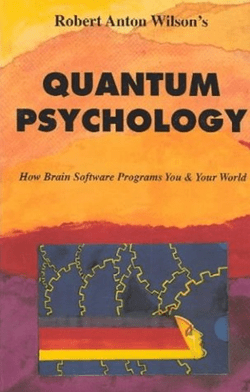


Der folgende Ausschnitt aus Robert Anton Wilsons “Quantum Psychology” zeigt das Allernormalste, Allgemeinste, total Unbezweifelte als das völlig Sinnlose. Die Zweikopf-Theorie nach Russell und klargestellt von Wilson. Lesen und nachdenken.
Die Darstellung in Wilsons Buch hat mich seit Jahren verfolgt. Das Buch, woraus sie stammt, irgendwo im Haus, unauffindbar. Vielleicht in den Kisten im Keller an der Riehentorstrasse. Ev. weggeworfen.
Lange habe ich nach Colin Wilson gesucht, ein anderer Spinner, aber das war der falsche Wilson. Heute gerät mir “Schrödingers Katze” von R.A. Wilson in die Finger und ich komme der Sache näher. Suche im Internet, finde die Quantum Psychology und weiss (80%), das ist das Buch. Auf deutsch längst vergriffen, nur noch für 210€ zu haben. Aber englisch noch greifbar, und erst noch auf Kindle. Und hier unten die heisse Stelle.
Die Sache ist einfach umwerfend. Phänomenal im wahrsten Sinne des Wortes. Und kein Mensch redet darüber. Niemand scheint es zu merken. Und es geht um nichts weniger, als die völlig unbestrittene wissenschaftliche Weltdarstellungs- und Erfahrungstheorie. Aber da ist gewaltig der Wurm drin. Warum fällt das niemandem auf? Warum schreit niemand?
Und noch eine Bemerkung: R.A.Wilson erwähnt nicht, oder bemerkt nicht oder weiss nicht (doch wohl kaum), dass hinter der ganzen Geschichte 500 Jahre europäischer, philosophischer Spekulation und endloses Rätselraten um die Natur unserer Realität steht. Beginnend mit Descartes und seinem Skeptizismus mit der Hypothese, dass möglicherweise ein Dämon uns die Illusion einer äusseren Realität eingibt (seine Lösung: der Dämon ist ein guter und heisst Gott).
Und dann kommen die Empiristen Locke, Berkeley und Hume und vor allem Berkeley lehnt die Vorstellung einer von uns unabhängigen äusseren Realität als reine Spekulation ab. Alles ist Bewusstsein. Trost findet er wie Descartes beim Gedanken, dass wir sozusagen im Geiste Gottes aufgehoben sind – warum war er schliesslich Bischof? Und in neuster Zeit haben wir die Brain in a Vat-Ideen von Hilary Putnam und drauf aufbauend oder zumindest davon inspiriert die Matrix-Filme der Wachowsky-Brüder. Also da gibt es rund um Russells Mehrkopf-Theorie doch noch allerhand aufzuarbeiten.
How Many Heads Do You Have?
Borrowing a joke (or a profundity?) from Bertrand Russell’s Our Knowledge of the External World, I will now demonstrate that the reader has two heads.
According to common sense, and the consensus of most (Occidental) philosophers, we exist „inside“ an „objective universe,“ or — to say it otherwise — the „objective universe“ exists „outside“ us.
Very few people have ever doubted this. Those who have doubted it have arrived, inevitably, at highly eccentric conclusions.
Well, then, avoiding eccentricity and accepting the conventional view, how do we know anything about that „external universe“? How do we perceive it?
</p></blockquote><p><!--more--></p><blockquote><p>
(For convenience, I will consider only the sense of sight in what follows. The reader can check for himself, or herself, that the same logic applies if one changes the terms and substitutes hearing or any of our other senses.)
We see objects in the „external universe“ through our eyes and then make pictures — models — of them in our brains. The brain „interprets“ what the eyes transmit as energy signals. (For now, we will ignore the data that shows that the brain makes a gamble that it can interpret these signals.)
Again, very few Occidentals have doubted this, and those who have doubted it all arrived at strange and incredible alternatives.
So, then, we live „inside“ an „external universe“ and make a picture or model of it „inside“ our brains, by adding together, or synthesizing, and interpreting, our pictures or models of parts of the universe called „objects.“ Then, it follows that we never know the „external universe“ and its „objects“ at all. We know the model of the „external universe“ inside our brains, which exist inside our heads.
In that case, everything we see, which we think of as existing externally, actually exists internally, inside our heads.
But we have not arrived at solipsism, remember. We still assume the „external universe“ from which we started. We have merely discovered that we cannot see it or know it. We see a model of it inside our heads, and in daily life forget this and act as
if the model exists outside our heads — i.e., as if (1) the model and the universe occupy the same area of space (as our map that tries to show „all“ about Dublin would occupy the same space as Dublin) and (2) that this space exists „outside.“
But the model and the universe do not occupy the same space and the space where the model exists can only be located „inside“ our brains, which exist inside our heads.
We now realize that, while the universe exists outside, the model exists inside, and therefore occupies much, much less space than the universe.
The „real universe“ then exists „outside“ but remains unexperienced, perhaps unknown. That which we do experience and know (or think we know) exists in local networks of electrochemical bonds in our brains.
Again, if the reader cares to challenge any part of this, she or he should certainly try to imagine an alternative explanation of perception. It will appear, or it has always appeared to date, that any and all such alternatives sound not only queerer than this but totally unbelievable to „people of common
sense.
Well, to proceed, we have now an „external universe,“ very large (comparatively speaking), and a model of same, much smaller (comparatively speaking), the former „outside“ us and the latter „inside“ us. Of course, some correspondence or isomorphism exists between the „external“ and „internal“ universes. Otherwise, I could not get up from my chair, walk to the door, go down the hall and accurately locate the kitchen to get another cup of coffee from something I identify as a Coffee Maker.
But where does our head exist?
Well, our head obviously exists „inside“ the „external universe“ and „outside“ our brain which contains the model of the „external universe.“
But since we never see or experience the „external universe“ directly, and only see our model of it, we only perceive our head as part of the model, which exists inside us. Certainly, our perceived head cannot exist apart from our perceived body as long as we remain alive, and our perceived body (including head) exists inside our perceived universe. Right?
Thus, the head we perceive exists inside
some other head we do not, and cannot, perceive. The second head contains our model of the universe, our model of this galaxy, our model of this solar system, our model of Earth, our model of this continent, our model of this city, our model of our home, our model of ourselves and atop our model of ourselves a model of our head. The model of our head thus occupies much less space than our „real“ head.
Think about it. Retire to your study, unplug the phone, lock the door and carefully examine each step of this argument in succession, noting what absurdities appear if you question any individual step and try an alternative.
Let us, for Jesus’ sake and for all our sakes, at least attempt to clarify how we can have two heads. Our perceived head exists as part (a very small part) of our model of the universe, which exists inside our brain. We have already proven that, have we not? Our brain, however, exists inside our second head — our „real“ head, which contains our whole model of the universe, including our perceived head. In short, our perceived head exists inside our perceived universe which exists inside our real head which exists inside the real universe.
Thus, we can name our two heads — we have a „real“ head outside the perceived universe and a „perceived head“ inside the perceived universe, and our „real“ head now appears, not only much bigger than our perceived head, but bigger than our perceived universe.
And, since we cannot know or perceive the „real“ universe directly, our „real“ head appears bigger than the only universe we do know and perceive — our perceived universe, inside our perceived head.
The reader might find some comfort in the thought that Bertrand Russell, who devised this argument, also invented the mathematical class of all classes that „do not contain themselves.“ That class, you will note, does not contain itself unless it does contain itself. Also, it does contain itself if and only if it does not contain itself. Got it?
When not busy crusading for rationalism, world peace, common decency, and other subversive ideas, Russell spent a lot of time in the even more subversive practice of inventing such logical „monsters“ to bedevil logicians and mathematicians.
Returning to our two heads: Lord Russell never carried this joke, or this profound insight, beyond that point. With a little thought, however, the reader will easily see that, having analyzed the matter this far, we now have three heads—the third containing the model that contains the „real“ universe and the „real“ head and the perceived universe and the perceived head. And now that we have thought of that, we have a fourth head…
And so on, ad infinitum. To account for our perception of our perception — our ability to perceive that we perceive — we have three heads, and to account for that, four heads, and to account for our ability to carry this analysis onward forever, we have infinite heads…
Du muss angemeldet sein, um einen Kommentar zu veröffentlichen.