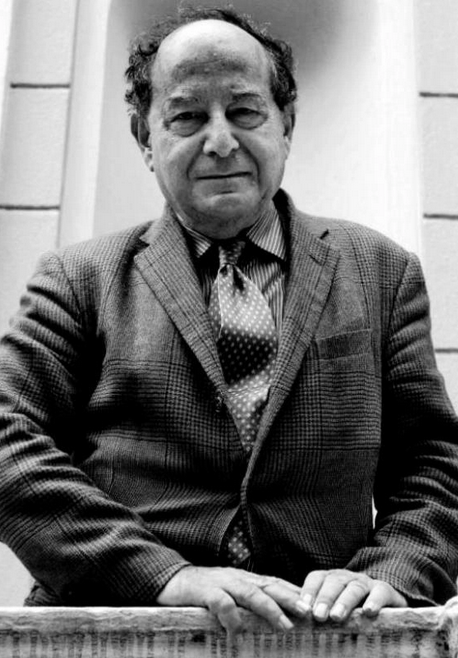
INTERVIEWER
What drew you to Baudelaire?
CALASSO
Baudelaire is the first non-Italian poet I truly read. In my grandfather’s house, there was a very large library and a beautiful studio. Before the studio, there was a room lined with books, and in the center was a big table with papers. As a kid I was there very often, looking at things I didn’t know anything about, and there I found a copy of Les fleurs du mal, in a fine edition done by Crès in the twenties. Crès was a very elegant publisher from a typographical point of view. I stole the book from my grandfather. It is the first and only book I have ever stolen. My grandmother noticed it because she had an eagle eye—besides, the book was inscribed to her by my grandfather. So she did something slightly perverse. She gave it as a gift, not to me, but to my mother. My mother, in her very last years, gave it to me. So there are three inscriptions in the book, and the last one is rather recent.
When I stole it, I must have been twelve. I was starting to learn French and, of course, I was attracted by the title—it was irresistible. I always had a special sense for Baudelaire, which I never had for any other poet—something more direct, more intimate. And I have to admit that the Folie Baudelaire was the book I wrote with the most ease.
INTERVIEWER
How long did it take you?
CALASSO
It took some time, because what you read now is only a part of the whole—I took out so many things. The book is not only about Baudelaire, but about the wave that, influenced by him, ran through France in the nineteenth century, both in literature and in art. Baudelaire was far more than a great poet. He established the keyboard of a sensibility that still lives within us, if we are not total brutes. The Tiepolo book was a big branch of this tree, and the branch detached itself because I felt it was a book and it had to be alone. So Tiepolo Pink was published before the Folie. I can’t judge exactly how long it took, perhaps around five years.
INTERVIEWER
That’s not exactly a rush.
CALASSO
Consider that L’ardore, my latest book, is something that has gone on with me since Ka, so more or less fifteen years. No other book of mine has taken so much time.
INTERVIEWER
You constructed the Folie Baudelaire around the dream of the “brothel-museum”?
CALASSO
Yes, the whole book converges toward that story—this strange creature, if you will, which is the brothel-museum dream, and where one finds all the strands of Baudelaire. But here’s an important point—that dream corresponds to a real and rather magical place in Paris, the Palais-Royal
eighteenth-century garden and colonnade. At the end of The Ruin of Kasch, there is a part called “Voices from the Palais-Royal,” where the Palais-Royal is presented as an ultimate image of our world—where everything concentrates and anything can happen. At once paradise and hell. The Palais-Royal notoriously housed prostitutes but also coffee houses, political meetings, science laboratories, and gambling parlors. And it was the place where Diderot used to sit on a bench and fantasize. It is an outside space, and the brothel-museum functions like a Baudelairian mirror world inside.
INTERVIEWER
Imagine if you had written all these books without narrative—it might have amounted to a sum of forbidding theories.
CALASSO
Maybe I’m inclined to what Nietzsche called “impure thought,” that is to say, a kind of thought where abstractions are so mixed with the facts of life that you can’t disentangle them. I feel thought in general, and in particular what is unfortunately called “philosophy,” should lead a sort of clandestine life for a while, just to renew itself. By clandestine I mean concealed in stories, in anecdotes, in numerous forms that are not the form of the treatise. Then thought can biologically renew itself, as it were.
INTERVIEWER
We are sitting in your study in Milan. Will you describe it?
CALASSO
This room where we are sitting is for me a tolerable approximation to paradise. You need to have a very big table first of all. A friend of mine designed this one. You must have many things on it. All the books you see here are what I need for the work I’m doing right now. In one corner there are papers connected with the publishing house. And here are many dictionaries. On the wall in front, it’s all Greece and Rome. On the wall behind, all India. It’s good to feel that you are in a room that contains a substantial part of the Loeb Classical Library and the Belles Lettres.
INTERVIEWER
How do you organize your library?
CALASSO
A proper answer would imply writing an autobiography. It reminds me of a delightful work by a seventeenth-century French scholar, Gabriel Naudé, Advis pour dresser une bibliothèque. For me there are several criteria—practical, aesthetic, capricious. The essential thing is to obey what Aby Warburg called the “law of the good neighbor.” When looking for a book, you may discover that you were in fact looking for the book next to it. It’s the principle on which the marvelous Warburg Library in London is based. And of course the positions of books change in the course of time. They become like a geologic system of layers. In my case, alas, the books are in different places—around twenty thousand in the basement of the publishing house, and more yet in another apartment.
INTERVIEWER
Your own books are, in a way, tributes to great poets and storytellers. Are there a few writers who accompany you always?
CALASSO
Proust. Kafka for sure. Baudelaire absolutely. Nietzsche. John Donne. And I wouldn’t want to limit myself to the West, so Yajnavalkya, Chuang Tzu. Yet I feel so unjust to so many if I start drawing lists.
INTERVIEWER
Here is a photo of you and your late friend Brodsky. He wrote a wonderful essay on The Marriage where he talks about self-projection. He draws a parallel between mythology and television. The scales and parameters are different, but myth and TV are both ultimately about self-projection. The seat of both is one’s mind. The altar in both cases is a box. Sacrifice is the remote control.
CALASSO
That’s highly Brodskian. The point is, man has a surplus of energy which he has to dispose of. That surplus is simply life. There is no life without surplus. Whatever one does with that surplus, that decides the shape of a culture, of a life, of a mind. There were certain cultures that decided they had to offer it in some way. It is not clear to whom, why, and how, but that was the idea. There are other cultures, like ours, where all this is considered entirely useless and obsolete. In the secular world, sacrifice shouldn’t have any meaning at all. At the same time, you realize that it does, because the word has remained very much in use. In discussions of the economy, analysts speak all the time of sacrifices, without realizing what is inside the word. Even in psychological terms, sacrifice is a most usual word. It is considered illegal—for instance, if one celebrated a sacrificial ritual in the middle of London or New York, he would do something illegal, he would be put in jail. Sacrifice is connected to destruction—that is an important thing and the most mysterious one. Why, in order to offer something, you must destroy it. These are the themes of the last part of L’ardore.
 wirth.blog
Du muss angemeldet sein, um einen Kommentar zu veröffentlichen.