Die Lage und die Aussichten von Grossbritannien

Matt Goodwin, Blogger auf Substack, hat den Text seiner Rede vor EU-Parlamentarier in Strassburg aufgeschaltet. Daraus die ersten Paragraphen. Beängstigend.

Why is British politics experiencing a historic political ‘realignment’ that will, if the polls are correct, deliver a Reform-led government, headed by Nigel Farage?

To answer this question, let me first set out a few facts about what is currently underway in Britain.
By the year 2063, white Britons will be a minority in the country.
Among the under-40s, this will happen much earlier, potentially as early as the year 2050 —only twenty-five years away.

By the year 2079, the foreign-born –people who were born outside Britain— and their immediate descendants, will represent a majority in the entire country.
In England, already today, more than 40 per cent of all babies have at least one parent who was born outside the country, with the most common including India, Pakistani, Nigeria, Bangladesh, Ghana, Afghanistan, and Iraq.

By 2100, by the end of this century, one in four British adults and roughly one in three young people, unless we change the direction of travel, will follow Islam.
Today, more than one million people in Britain do not speak English, while in more than 2,000 schools a majority of children do not speak English as their first language.
Muhammad, including variants of the name, has been the most popular boys name in Britain, since 2016.

And in many areas of the country, somewhere between 20 and 40 per cent of people from minority backgrounds openly reject an English, British, and UK identity.
All these things points to the answer to the question of why British politics is currently in a state of profound and historic change —a political realignment.
We have an immigration crisis, a demographic crisis, which nobody in Westminster is seriously responding to. And this crisis has two key elements.
The first is the illegal migration crisis.

According to the Pew Research Centre, there are more than one million illegal migrants living and working in Britain, today.
They are now being joined by nearly 200,000 additional unvetted illegal migrants, who are arriving on the small boats from France.
And if the current average trend continues, they will soon be joined by another 181,000 illegal migrants on the small boats by the next general election.
More unvetted migrants have now crossed into the country on the small boats than we currently have people serving in the British armed forces.
Nobody voted for this. Nobody wants this.
Yet once they have entered Britain illegally, they are then sent by our current Labour government into the very heart of our local communities –next to families, next to schools, next to synagogues, next to children.

The cost of this absurd police is some £5.7 million a day for the hardworking British taxpayer, or £15 billion over the next decade.
We don’t know who these people are.
We don’t know where they are from.
We don’t know what they believe.
We don’t know why they are here.
What we do know is they have included supporters of Islamic state, murderers, rapists, and “alleged” Iranian terrorists and that Islamic state has been using Europe’s migration crisis to infiltrate Western nations.

Blog

Welche Umwelt-Krise?

CO2 ist ein Treibhausgas, unter anderem. Aber ohne könnten wir nicht überleben. Ohne CO2 gäbe es auf der Erde kein Leben. Und seine Treibhauswirkung ist denkbar gering. Selbst eine Verdoppelung des Anteils hätten kaum Wirkung. Auch keine Vervierfachung. Die Null-Emission Politik ist grober Unsinn. Zudem: der etwas höhere Anteil in der Atmosphäre hat weltweit zu verstärktem Pflanzenwuchs geführt, insbesondere in der Sahel-Zone, im Westen Indiens und Australiens. Der CO2 Anteil ist auf einem historischen Tiefstand. Es referiert Will Happer, ein Mann mit allen erdenklichen Titeln und Kompetenzen auf diesem Feld.

YouTube

Das Elend des Metropolitan

imageThe New Criterion berichtet in der Dezemberausgabe, die heute bei mir eingetroffen ist, über die Vorgänge am New Yorker Metropolitan Museum unter seinem woken Direktor Max Hollein. Man muss das einfach als widerlich bezeichnen, auch was seine weiteren Aktionen als Met Direktor betrifft.

In June, Keith Christiansen (Bild), the museum’s chairman of European paintings, posted to his personal Instagram feed a print featuring Alexandre Lenoir, a figure who tried to save monuments during the French Revolution. „Alexandre Lenoir battling the revolutionary zealots bent on destroying the royal tombs in Saint Denis,“ Christiansen wrote. „How many great works of art have been lost to the desire to rid ourselves of a past of which we don’t approve?“

The post came at a moment of national riots that had quickly moved beyond the dismantling of Confederate monuments to the indiscriminate destruction of any and all public works. „And how grateful we are to people like Lenoir, Christiansen continued, „who realized that their value-both artistic and historical-extended beyond a defining moment of social and political upheaval and change.“

A member of the Metropolitan staff since 1977, Christiansen well understood that the en- cyclopedic museum, including his own, is the direct descendant of Lenoir. From the French Revolution, coming out of the American Civil War, on through the Monuments Men of the Second World War, collecting institutions have saved culture from the forces of destruction. „The losses that occur when major works of art are destroyed by „war, iconoclasm, revolution, and intolerance,“ as he explained, are the enemies of art history, diminishing our „fuller understand- ing of a complicated and sometimes ugly past?‘

Christiansen was denounced for daring to compare Jacobin-like terror to the Jacobin Terror. This fall, he was among the 20 percent of Met staff to announce their retirement, to resign, or to be pushed out. One of his final acts at the museum has been the restoration of the second floor skylights for its collection of European paintings. It took one hundred and fifty years for that light to make the Met what we see today. It might take far fewer for the museum’s future to dim into its unmaking.

The New Criterion, Dez. 2020
The mob comes for the art world

Tote Städte, lausige Architektur

Vittorio Magnago Lampugnani beschreibt in der NZZ einen offenkundige, selten thematisierten Zustand. Ausgehend von einem Architekturvortrag vor über 100 Jahren, gehalten von einem Hendrik Petrus Berlage, schreibt Lumpagnani:

Es war der niederländische Architekt Hendrik Petrus Berlage, der vor über hundert Jahren diese Auffassung vertrat, und zwar in einem Vortrag mit dem Titel «Baukunst und Impressionismus». Bis dahin waren die städtischen Häuser Gebilde mit komplex artikulierten Hüllen gewesen. Sie waren in Hauptteil, Basis und Attika gegliedert, die jeweils anders gestaltet und oft auch aus anderen Materialien hergestellt waren: der Sockel widerstandsfähig, weil am exponiertesten, und schwer, um Solidität zu vermitteln, die Attika leicht und licht, allenfalls mit kräftigem Gesims, um den oberen Gebäudeabschluss zu markieren. Dazwischen waren die Fenster rhythmisch in die Fassade eingeschnitten, wobei Rahmen oder Faszien den Übergang zwischen Fläche und Öffnung thematisierten.

Die Fensterbänke standen stärker vor, um Wassernasen zu vermeiden, aber auch um dem Fenster mehr Halt in der Wand zu verleihen. Die Fensterläden waren in die Gesamtkomposition integriert. Flächige oder plastische Zierelemente unterstrichen sie und fügten dekorative und erzählende Dimensionen hinzu, die das Haus mit seiner Nutzung, seinem Bauherrn oder einfach nur seiner Zeit verknüpften. All das, so Berlage, war nunmehr anachronistische Verschwendung und würde vom neuen, rasanten Lebensrhythmus dahingerafft werden.

Von da vorwärts zur Gegenwart, mit Häusern und Städten,  die gebaut wurden für die Insassen “rasender Automobile”, welche für architektonische Feinheiten weder Zeit noch das Auge haben.

Weiterlesen

Paris / Louvre etc.

25. bis 29. Januar Paris, Spira im Dojon. Übernachtung im Monterosa, Rue de la Bruyère.

Am 28. im Louvre. Zur Erinnerung der riesige Veronese (Hochzeit von Kanaan). Im selben Saal wie die Mona Lisa. Nur halt so viel interessanter. Der etwas leblose Jesus in der Mitte mit seinem durchdringenden Blick. Ganz links (hier nicht sichtbar) die Braut mit Bräutigam. Dazu die Hunde, die Musiker und tausendundein Symbole. Grosses Kino, wie man so sagt. 

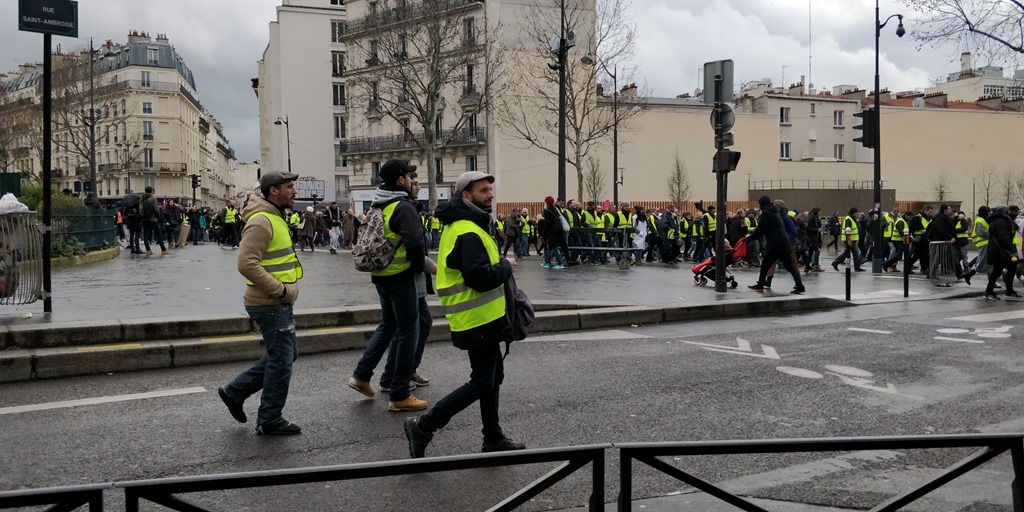
Unten die Gilets Jaunes im Original auf dem Boulevard Voltaire. Ganz passend.

Nachtessen jeweils mit Dora und Urs. Auf dem Bild im edlen Vegi-Italiener beim Gare du Nord.

IMG_20190126_214211IMG_20190128_135231IMG_20190126_133558

Das Kekulé -Problem

Ähnliches FotoUnterbewusste hat offenbar stark an Faszination eingebüsst. Man fragt sich, ob es dereinst bewusste Maschinen geben wird. Ob diese auch ein Un- oder Unterbewusstes haben werden, auf die Frage scheint noch niemand gekommen zu sein. Cormag McCarthy ist auf Nautilus  dem Unterbewussten  nachgegangen, und welche Rolle die Sprache spielt.

Kekulé hat die Form des Benzol-Rings entdeckt, im Schlaf während eines Traums, in Form des Uroburos, der Schlange, die sich in den Schwanz beisst. Da war das Unterbewusste aktiv, aber es hat sich nicht mit einer sprachlichen Aussage gemeldet, sondern mit einem Bild, einem Symbol. Das ist typisch für das Unterbewusste, schreibt McCarthy. Es habe nämlich eine Abneigung gegen Sprache, die ihm aufgepfropft wurde. Zudem ist die Sprache kein evolutionäres Produkt, sondern eine Erfindung. Warum aber das UB die Sprache nicht benützt, ist das eigentliche K-Problem. Zur Sprache schreibt er: 

The sort of isolation that gave us tall and short and light and dark and other variations in our species was no protection against the advance of language. It crossed mountains and oceans as if they werent there. Did it meet some need? No. The other five thousand plus mammals among us do fine without it. But useful? Oh yes. We might further point out that when it arrived it had no place to go. The brain was not expecting it and had made no plans for its arrival. It simply invaded those areas of the brain that were the least dedicated. I suggested once in conversation at the Santa Fe Institute that language had acted very much like a parasitic invasion and David Krakauer—our president—said that the same idea had occurred to him. Which pleased me a good deal because David is very smart. This is not to say of course that the human brain was not in any way structured for the reception of language. Where else would it go? If nothing else we have the evidence of history. The difference between the history of a virus and that of language is that the virus has arrived by way of Darwinian selection and language has not. The virus comes nicely machined. Offer it up. Turn it slightly. Push it in. Click. Nice fit. But the scrap heap will be found to contain any number of viruses that did not fit.

Das Kekulé-Problem hat McCarthy übrigens auch gelöst.

I’d been thinking about the Kekulé problem off and on for a couple of years without making much progress. Then one morning after George Zweig and I had had one of our ten hour lunches I came down in the morning with the wastebasket from my bedroom and as I was emptying it into the kitchen trash I suddenly knew the answer. Or I knew that I knew the answer. It took me a minute or so to put it together. I reflected that while George and I had spent the first couple of hours at cognition and neuroscience we had not talked about Kekulé and the problem. But something in our conversation might very well have triggered our reflections—mine and those of the Night Shift—on this issue. The answer of course is simple once you know it. The unconscious is just not used to giving verbal instructions and is not happy doing so. Habits of two million years duration are hard to break. When later I told George what I’d come up with he mulled it over for a minute or so and then nodded and said: “That sounds about right.” Which pleased me a good deal because George is very smart.

Artikel Nautilus

Piketty: Produktivität in Deutschland und Frankreich

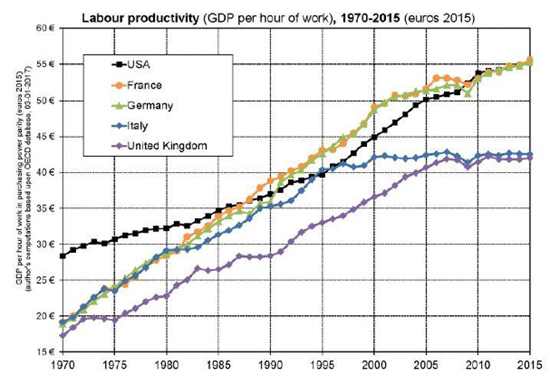
Pikettys Bestseller über den Kapitalismus und seine fatalen Mängel habe ich nicht gelesen und über seine Schlussfolgerungen – massive steuerliche Mehrbelastung der Superreichen –  bin ich nur oberflächlich orientiert. Hege aber eine instinktive Skepsis. Gelesen habe ich dafür seinen Blogbeitrag bei LeMonde mit einer Analyse der Produktivität und ihrer Entwicklung in einer Reihe von Ländern und insbesondere einem Vergleich von Deutschland und Frankreich, der überaus interessant ist und jede Menge an Fragen aufwirft. Piketty definiert Produktivität schlicht aus der Division von Sozialprodukt und Anzahl geleisteter Arbeitsstunden. Über die Mängel der Definition ist er sich im klaren, hat aber Einwände gegen die näherliegende Definition als Quotienten aus Volkseinkommen und Arbeitsstunden.

image

Was auffällt, ist ab 2000 das Wegbrechen von Italien und Grossbritannien und der anhaltende Gleichschritt von USA, Deutschland und Frankreich. Was ist da passiert? Was ist in Italien geschehen? Ich vermute, hier machen sich erstmals und dramatisch die Konsequenzen des Euros bemerkbar, was P. als Anhänger der Einheitswährung wohl nicht sehen will. GB fällt ab ca. 2008 zurück, auch ohne Euro, während Frankreich im Gleichschritt mit den USA und D vorwärts marschiert. Wie ist das zu interpretieren?

image

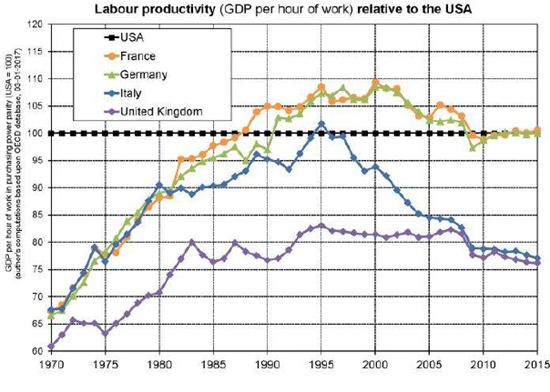
Noch auffallender, wenn man die Zahlen akzeptiert, ist die Tatsache, dass USA, D und F gleichauf liegen, I und GB hingegen weit hinter den USA als Massstab zurückfallen. Das ist der selbe Tatbestand wie in der ersten Grafik, mit anderer Optik und den USA als Massstab.

image

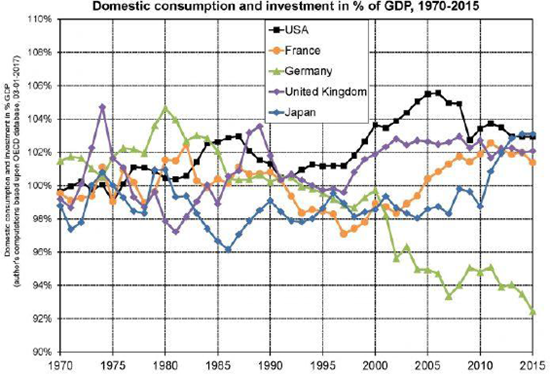
Was Piketty besonders stört, ist das tiefe Konsum und Investitionsniveau in Deutschland, das deutlich von allen Vergleichsländern abweicht. Wo gehen dann aber die Ueberschüsse hin? Der deutsche Staat hat sich bis ca. 2015 stets weiter verschulden müssen, die Realeinkommen in Deutschland haben nicht wesentlich zugenommen. Sind sie bei den Unternehmen gelandet?

Und das geht einher mit enormen Exportüberschüssen in Deutschland. Piketty kommentiert:

After unification, the German governments were very afraid of a drop-off in the competitiveness of the German production site‘. They adopted wage-freeze policies to increase productivity and they probably went too far in this direction. At the same time, the entry of Central and Eastern European countries into the European Union enabled German firms to achieve an increased and highly advantageous integration with these new countries. This can be seen in particular with the explosion of the general level of imports and exports, which were very similar to the level in France in 2000 (close to 25%-30% of GDP) and which in 2015 rose to 40%-45% of GDP in Germany (as compared with 30% in France; see the graph above).

This all led to a trade surplus which was doubtless not entirely foreseeable and is in large part due to contingent factors. In its own way, it is an illustration of the strength of the economic forces at play in globalisation which public authorities have not yet learnt to regulate correctly.

Weiterlesen

Narzissmus ist keine bürgerliche Tugend

imageDie NZZ gibt bekannt, dass Claudia Wirz, Redaktorin, künftig in einem freien Auftragsverhältnis zur Zeitung stehen werde. Das macht Hoffnung, dass man die Frau mit dem Wuschelhaar künftig nicht nur weiter dort lesen kann, sondern dass sie auch anderweitig  publizieren, vielleicht sogar ein Buch schreiben wird. Man würde es gerne lesen. Wirz schreibt so munter und gut und witzig und intelligent wie wenige in der Schweiz. Ihr “Abschiedsartikel”, “Das Land wo die Neurosen blühn”, ist dafür ein gutes Beispiel. Hier ein Zitat:

Die Doktrin der politischen Korrektheit erlaubt keine Kompromisse. Sie auferlegt dem Staat, nicht nur jede Lebensweise und jedes Bedürfnis zu respektieren, sondern sie auch gebührend zu unterstützen. Ein gutes Geschäft, ja eine regelrechte Industrie tut sich da auf. Mit den Ansprüchen und den Anspruchsgruppen wachsen auch der Staat und die ihm zugewandten Orte. Kritisches Hinterfragen ist verboten. Beispielhaft zeigt sich das anhand der Familienpolitik. Noch nie war die Familiengründung so frei von Zwängen wie heute. Das ist schön und urliberal. Aber freie Entscheide sind nicht nur schön, sondern auch anspruchsvoll. Sie implizieren die Bereitschaft, die Konsequenzen des eigenen Tuns selber zu tragen. Freiheit heisst immer auch Verantwortung. Doch das hat nicht nur die «Generation Selfie» verlernt. Man hält sich gerne alle Optionen offen, der korrekte, fürsorgerische Staat kann nicht anders und wird schon herbeieilen, um die Risiken abzufedern, wenn’s zum Beispiel mit der innerfamiliären Solidarität knapp wird. Und so werden die Leistungen der staatlichen Kundendienstzentrale laufend ausgebaut, und das Personal wird aufgestockt.

Natürlich gab es gleich Proteste und Artikel, die das Gegenteil behaupteten. Die guten Menschen fühlten sich verletzt und missverstanden. Nur leider können sie alle nicht annähernd so gut schreiben. Selbst wenn sie recht hätten, kann das nicht interessieren.

Artikel Wirz

Techno-Religions and Silicon Prophets

Denkbare, wünschbare Zukunft oder Horror-Szenario? Einziger Ausweg aus der drohenden Selbstzerstörung des Menschen oder materialistische Fehlzündung auf Basis einer irregeleiteten Ontologie? Man sollte seine Bücher (oder besser: Homo Sapiens) gelesen haben, um eine Idee von einer offenbaren, globalen Tendenz zu bekommen. Sonst marschieren wir schnurstracks in eine makabre neue Welt, scheinbar ohne Alternative.

Was ist das für eine Welt? Der (biologische) Mensch ist ersetzt durch Chips und Software. Das erlaubt ihm, durch Raum und Zeit zu reisen und die (neue) Spezies auf anderen Planeten zu verbreiten, etwa wie Viren.

Das tönt wie die übliche Dystopia, aber Harari ist ein hochintelligenter Typ und so leicht nicht zu widerlegen. On verra – oder besser nicht.

Zum Buch von Harari